The Practical Matching Logic for Electric Hoists
When many factories purchase electric hoists, they habitually look first at tonnage and price, treating the workshop environment as a secondary factor. In actual use, the truly troublesome problems are often not the inability to lift, but the inability to install, short service life, and inaccurate positioning. The same two-ton load, a model that works perfectly on a standard factory overhead crane, may get stuck on headroom when moved to a low-profile mold maintenance workstation; equipment that performs stably in a dry warehouse may experience control failure within half a year when placed next to a plating line. The starting point for selection should not be the product catalog, but the workstation itself.
Measure the Space First, Then Discuss the Model
The vertical space the workstation leaves for the electric hoist is the first data point that needs to be precisely confirmed. Many people only calculate the factory clear height, ignoring the rail height, the hoist's own structural height, and the space occupied by the hook block. The correct approach is to work backward from the lowest point the hook needs to reach: the lifting height must cover the workpiece lifting height, plus the hook block height and a safety margin, usually reserving half a meter to one meter to avoid topping out or frequent limit switch activation.
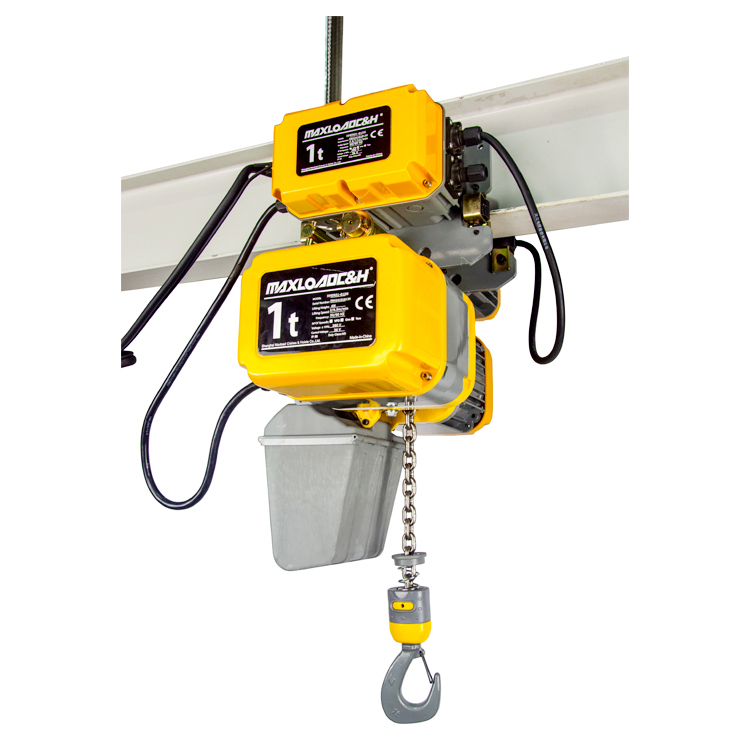
When this backward calculation reveals that a conventional wire rope hoist cannot fit, that is when the low-headroom chain hoist should come into consideration. The body cross-section of a chain hoist is much more compact than that of a wire rope hoist of the same tonnage. In situations such as old workshop renovations, mold lifting workstations, or where ventilation ducts and cable trays already occupy space overhead, it can gain an extra twenty to thirty centimeters of effective travel for the hook. Conversely, if the workstation has ample ceiling height and a large span, a wire rope hoist has more margin in lifting height and running stability, and there is no need to sacrifice long-term reliability for compactness.
Work Rhythm Determines the Control Method, Not the Other Way Around
The requirements that the workstation's production rhythm places on the electric hoist are far more complex than "being able to lift." A maintenance workstation that only lifts molds two or three times a day is perfectly served by a single-speed hoist—simple structure, few failure points, low maintenance cost. But if it is a fixed loading/unloading workstation on an assembly line where workpieces need to land precisely on fixtures, the swaying of a single-speed hoist during start and stop becomes a real problem: workpiece collisions, repeated positioning adjustments, and operators forced to develop a "jogging" habit, which in turn shortens contactor life.
Such applications require two-speed or variable-frequency control. The value of the slow speed is not in being "slow," but in the acceleration during start and stop being gentle enough that the workpiece does not swing from inertia and can be fine-tuned before landing. It should be noted that two-speed models cost more and are more complex to maintain than single-speed ones, and are only worth the investment when the workstation rhythm genuinely demands frequent precise positioning. If positioning is only needed occasionally, it is more cost-effective for the operator to wait a second or two for the swaying to stop before lowering the hook.
The Environment Is Not Just About Temperature—Look at "What Is Corroding the Equipment"
An ordinary workshop that is dry, at room temperature, and low in dust will see a standard protection-rated hoist run for years without major problems. But differences in workstation environments often hide in the details. In humid environments, such as near washing stations or in underground workshops, moisture seeps in through control box seals, button interfaces, and brake gaps, causing contactor corrosion or brake slippage. In such cases, the protection rating should be at least IP55 or above, and the sealing of the push-button pendant is equally important—you cannot just look at the number on the motor nameplate.
In dusty environments, such as near grinding stations or powder feeding ports, dust can clog brake gaps or enter the trolley track, causing delayed braking or sluggish travel. In addition to raising the protection rating, the lubrication cycle should be shortened, and consideration should be given to moving the control box outside the dust settlement zone. Corrosive environments are even more insidious: acid mist near plating and pickling stations will not immediately cause equipment failure, but it will accelerate wire rope corrosion and chain joint seizure. Wire rope hoists are more corrosion-tolerant in this scenario than chain hoists, because wire rope failure can be detected in advance through routine visual inspection, whereas chain joint seizure often occurs internally, and by the time sluggish operation is noticed, wear has already occurred.
If the workstation contains flammable gas or dust, the selection logic changes entirely. The motors, contactors, and buttons of ordinary hoists can produce arcs during any switching operation, and this cannot be avoided by "careful operation." The requirement for explosion-proof models is not "more rugged," but that all components that may produce sparks are enclosed in flameproof housings, or that spark-free designs are adopted at the source. This judgment must be determined by the hazardous area classification of the workstation, not by gut feeling.
Load Must Not Be Selected "Right at the Rated Value"
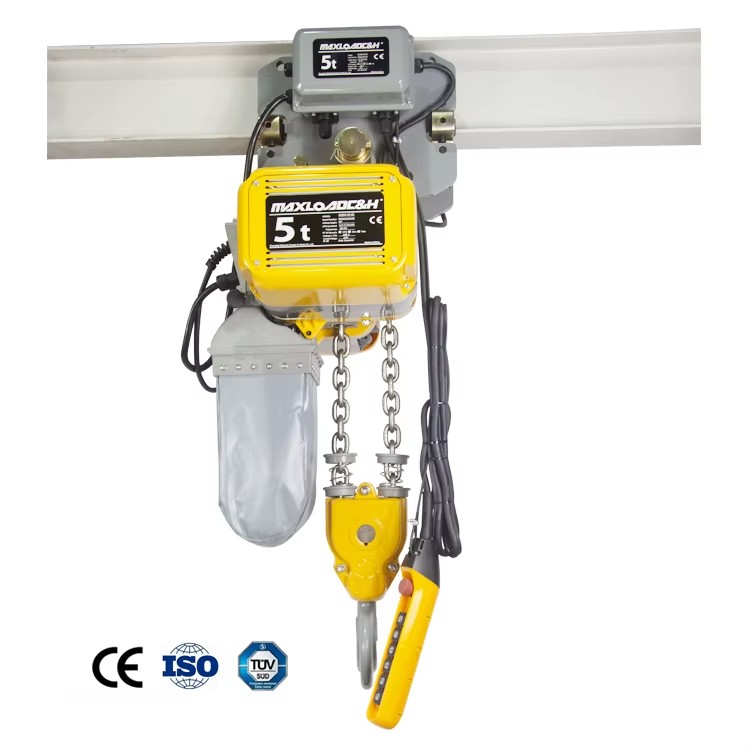
The maximum workpiece weight actually lifted at the workstation, plus the weight of lifting attachments and rigging, should not directly correspond to the hoist's rated capacity. The impact at the moment of lifting, the swinging of the workpiece during transport, and the performance degradation of the equipment after long-term use all require a margin to absorb. For conventional intermittent-duty conditions, reserving about a quarter of margin on top of the calculated total weight is reasonable; if the workstation operates frequently, or if the workpiece may adhere or jam during lifting, the margin should be increased to half.
Another easily overlooked parameter is the duty class. The same two-ton hoist: M3 corresponds to applications with cumulative daily operating time not exceeding two hours and small load fluctuations, while M5 corresponds to high-frequency operations of four to eight hours per day with larger load fluctuations. If the workstation only lifts a few pieces occasionally each day, M3 is sufficient; but if it is a fixed workstation beside an assembly line where the hoist operates continuously with the production rhythm, the motor and brake wear of an M3 model will far exceed expectations. The duty class is not directly reflected in daily operating feel—what it determines is whether the failure rate six months later is two percent or ten percent.
A Detail That Is Easily Skipped but Must Be Confirmed
Power supply. Whether the power reserved at the workstation is three-phase 380V or single-phase 220V directly eliminates a considerable number of models. Many small workstations or retrofit projects only have a single-phase outlet reserved, yet a standard industrial hoist is planned for installation, and only upon equipment arrival is it discovered that rewiring is needed. This is not a major problem, but it is enough to delay the installation plan by several days. Spending two minutes checking the workstation distribution box during the selection confirmation stage is much less trouble than coordinating with an electrician afterward.
Ultimately, the core of workstation environment selection is not memorizing how many rules, but getting the order right: first confirm the hard constraints that cannot be changed, such as space and power supply; then judge the requirements that determine the control method, such as operating frequency and positioning accuracy; and finally use environmental corrosiveness and hazard to screen the protection rating and model category. Tonnage is the starting point, but not the endpoint. A hoist whose parameters match perfectly on paper, if it cannot fit into that workstation, or if its brake seizes after three months due to dust, then no matter how accurate its rated capacity is, it is meaningless.
 0086 156 1824 5535
 0086 156 1824 5535