The Underlying Logic and Practical Framework for Electric Hoist Selection
When purchasing electric hoists, most people are accustomed to looking first at tonnage and price—and this is precisely the root cause of frequent later-stage failures. Tonnage only answers "can it lift it," whereas the workstation environment answers "can it continue to lift safely under specific conditions." The same two-ton rated-capacity hoist might last eight years in a dry assembly workshop, but by an acid-pickling line it may develop brake slippage and control-box corrosion within two years. The erosion of equipment lifespan and personal safety by the environment is gradual and irreversible.
I. Look at Space First: Clearance Height Determines the Model Route
The first hard constraint of the workstation environment is often not tonnage but vertical space. In old plant renovations or low-ceiling workshops, piping, cable trays, and lighting are also arranged below the roof, and the clearance left for the hoist may be less than half a meter.
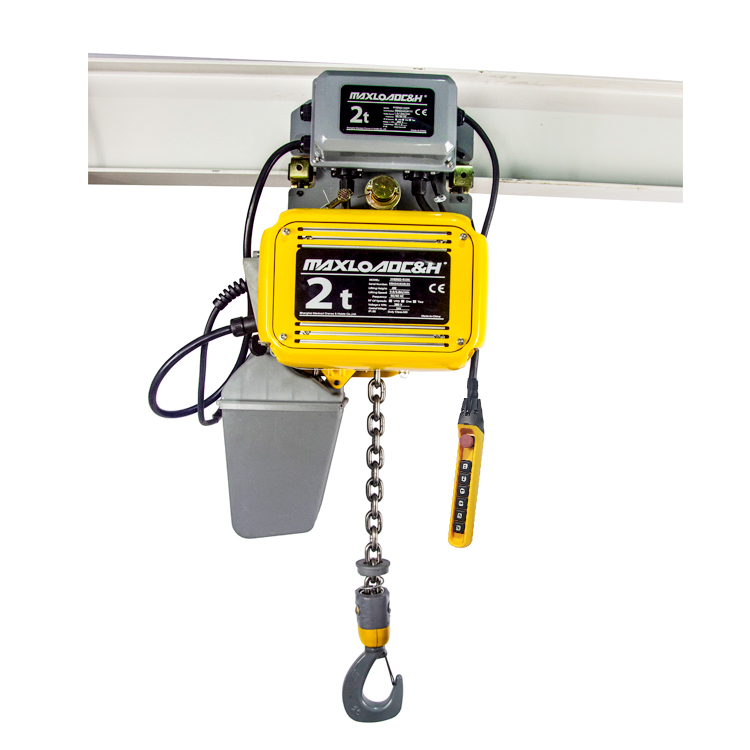
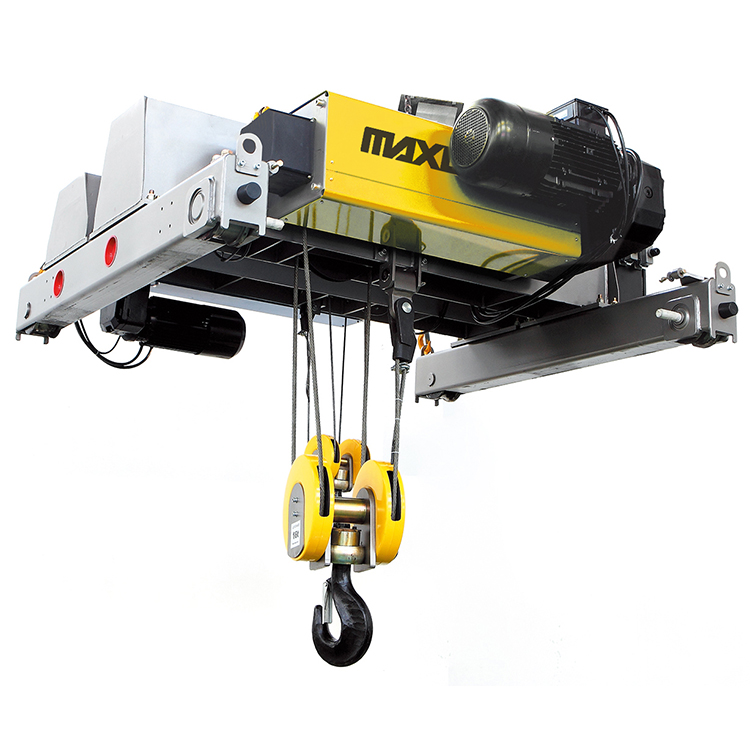
At this point, it is necessary to distinguish between two model routes. The drum structure of wire-rope electric hoists means their bodies are taller, but they offer large lifting heights and smooth operation, making them suitable for workstations with ample ceiling height and longer travel distances. If the plant clearance is severely limited, the compact body of the chain electric hoist is almost the only solution—its structural characteristics allow installation within extremely limited vertical space while retaining usable lifting travel. When selecting, do not look only at the "body height" in the catalog; measure the actual clear distance from the lower edge of the track to the highest obstacle at the workstation, then deduct the space occupied by the hook block and rigging—what remains is the effective lifting height.
II. Next, Look at Environmental Media: Higher Protection Rating Is Not Always Better, but It Must Match
The protection rating of an electric hoist is the core indicator of environmental adaptability, but many purchase orders simply write "IP54" and leave it at that, ignoring the differences in the forms of dust and moisture.
For conventional dry workshops, IP44 or IP54 is basically sufficient. But in grinding workstations, powder feeding areas, or the sand-cleaning areas of foundries, fine suspended dust particles in the air will continuously infiltrate the motor and brake. Once dust accumulates on the brake friction surfaces, braking torque will decrease unpredictably. In such working conditions, the dust-proof capability of electrical components should be raised above IP54, and structures with better brake sealing should be preferred. Humid environments follow a different logic: in workstations where humidity remains above 85% for long periods, such as beside washing lines or in underground warehouses, motor insulation performance will gradually deteriorate. The protection rating should be at least IP55, and motors above 10 kW are recommended to be equipped with preheating and drying devices to maintain winding temperature during shutdown periods and drive off condensation.
As for acid-alkali mist or salt-spray environments, simply raising the IP rating is not enough. The outer shell coating system, the plating of exposed fasteners, and the surface treatment of chains or wire ropes all need special confirmation. If surface treatment is inadequate, no matter how high the protection rating is, it cannot stop corrosion from spreading starting from structural components.
III. Special Hazardous Environments: Explosion Protection and High Temperature Are Two Independent Red Lines
If flammable gases, vapors, or dust exist at the workstation, the selection logic switches directly from "durability" to "safety," with no room for compromise. The core of an explosion-proof electric hoist lies not in being "sturdy" but in the flameproof enclosure—all components that may produce arcs or high temperatures, such as the motor, control box, and push-button switch, are enclosed in shells capable of withstanding an internal explosion without igniting the external environment. During selection, the hazardous area classification of the workstation must be confirmed, and the coverage of the equipment's explosion-proof marking must be checked. Replacing whole-machine explosion protection with an ordinary hoist plus explosion-proof buttons is a typical violation.
The criteria for judging high-temperature workstations are easily underestimated. At workstations near melting furnaces, heat-treatment lines, or casting pouring areas, the ambient temperature may far exceed the 40°C upper limit of conventional hoists. In such scenarios, what needs to be confirmed is not only the motor insulation class but also the configuration of heat shields and the thermal stability of the brake. Workstations handling molten metal fall under the category of special equipment, with mandatory requirements for dual braking systems and high-temperature-resistant wire ropes, which are fundamentally different from ordinary high-temperature lifting. If only hot castings rather than molten liquid are being lifted, selection can be appropriately relaxed, but heat insulation measures and high-temperature-resistant grease are still necessary configurations.
IV. Work Rhythm and Speed: The Basis for Choosing Single-Speed or Dual-Speed
The workstation rhythm determines the hoist's "duty" rating and also determines whether single-speed or dual-speed is appropriate.
For occasional lifting in warehouses or intermittent use at maintenance workstations, single-speed models are fully adequate, with fewer failure points and simpler maintenance. But for fixed-point loading and unloading on assembly lines or precise workpiece positioning, the start-stop impact of a single-speed hoist will cause the load to sway, and operators have to repeatedly jog to stabilize the load, which instead accelerates wear on contactors and brakes. Dual-speed models can achieve smooth start-stop and millimeter-level fine adjustment in the slow-speed gear. For workstations such as mold assembly and machining loading and unloading that need "stability" rather than "speed," the efficiency gain from dual-speed lies not in the speed itself but in reducing the time loss from repeated adjustments.
It should be noted that high-frequency workstations should also pay attention to the motor's duty rating. For hoists of the same nominal 2-ton capacity, motors with 25% and 40% duty cycles differ significantly in temperature rise performance under continuous assembly-line operation. This inconspicuous percentage on the catalog determines whether the equipment will shut down due to overheating during peak season.
V. Operation Mode and Personal Safety: Blind Spots in Ground Control
Many workstations use ground pendant control, with the operator walking along with the suspended load. This mode is acceptable in short-distance, low-frequency scenarios, but in long-travel or high-rhythm workstations it poses hidden risks: the operator's attention is focused on the load and easily neglects obstacles behind them or the risk of being pinched between themselves and the equipment.
A more reasonable approach is non-following control, that is, the pendant is suspended from an independent slide track, allowing the operator to observe the overall situation and operate from a position away from the load. If the workstation layout requires following operation, the hoist's travel speed should be controlled within a reasonable range to avoid forcing the operator to trot to keep up with the equipment. In addition, whether multiple pieces of equipment work in crossing operations at the workstation and whether the operator's line of sight is blocked by columns or equipment should all be confirmed on site before selection. Lifting limiters and travel limiters are standard, but whether the trigger positions of the limit switches match the actual travel of the workstation needs to be calibrated one by one during installation and commissioning, and cannot rely on factory defaults.
VI. Two Pre-Confirmations That Are Easily Overlooked
Power supply conditions. Whether the existing power supply at the workstation is three-phase 380V or single-phase 220V directly rules out a considerable number of models. If an old workshop or temporary workstation has only single-phase power, large-tonnage hoists cannot start, and power supply modification or selection adjustment must be completed before the equipment enters the site.
Track and installation interface. Is the hoist to be hung on existing I-beams, or does it require a matching trolley and track system? Does the flange width of the existing track match the wheel-gauge adjustment range of the hoist trolley? These issues are often classified as "accessories" in purchase contracts, but in actual installation, a single dimensional mismatch may prevent the entire machine from being mounted or cause rail gnawing during operation.
The essence of workstation environment selection is to distinguish "usable" from "suitable." Tonnage and price only solve the former, while protection rating, duty rating, explosion-proof/high-temperature configuration, control logic, and installation interface determine how long the equipment can last at a specific workstation, how many failures it will produce, and whether it will become a safety hazard. It is recommended to complete a workstation information sheet before requesting quotations: clearance dimensions, ambient temperature and humidity and media, hazardous area classification, average daily lifting frequency, power supply conditions, and existing track interface. Once these six items are filled in clearly, the selection range will naturally narrow, and subsequent procurement negotiations will have a stronger basis.
 0086 156 1824 5535
 0086 156 1824 5535