Five Technical Dimensions for Matching Electric Hoists
The essential difference between workstation lifting and general workshop lifting is that the former often compresses requirements for space, cycle time, and precision into an extremely limited range. Choosing a unit one size larger may mean it cannot fit; choosing one size smaller leads to frequent failures. What truly determines whether an electric hoist is "suitable" is often not the single number of tonnage, but the matching relationship among workstation clearance, operating frequency, environmental media, and operating method. The following expands on five quantifiable and verifiable dimensions.
I. Measure Clearance First, Then Discuss Tonnage
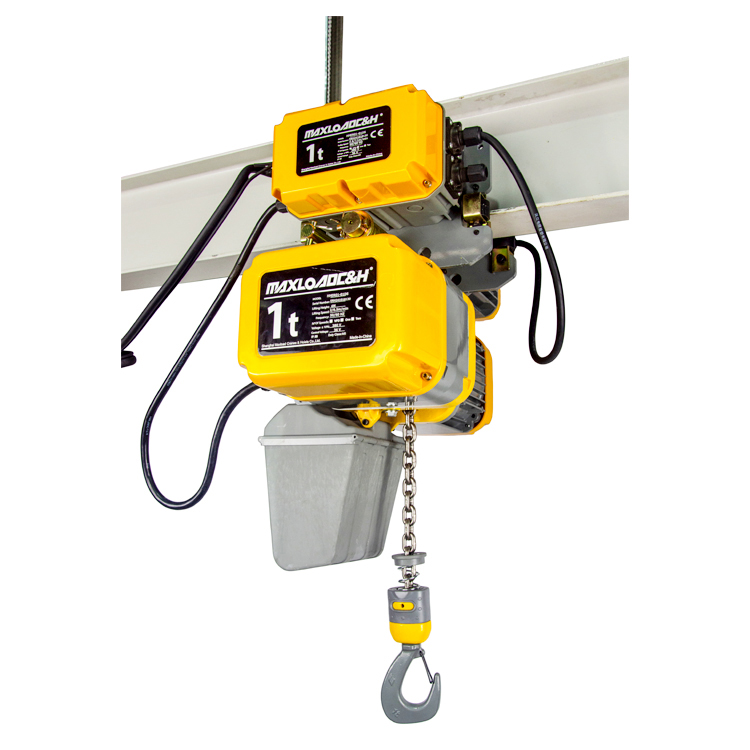
The most common mistake in workstation selection is discovering only after the equipment arrives that the lifting height is insufficient. The effective lifting stroke is the remaining value after subtracting the rail beam height, the hoist's own structural height, and the hook block height from the factory building's clear height. Conventional wire rope hoists offer large lifting heights and smooth operation, suitable for locations with ample floor-to-ceiling height; however, in old workshop renovations or low-clearance workstations, where the top space is often largely occupied by piping and cable trays, low-headroom chain hoists should be given priority. Chain hoists have a thinner body profile and can provide several hundred millimeters of additional usable stroke under the same installation conditions—a difference that directly determines whether workpieces can smoothly disengage from fixtures at workstations with frequent loading and unloading.
Tonnage calculation likewise cannot rely solely on workpiece dead weight. The weight of spreaders, rigging, and tooling fixtures must be included in the total load, and the dynamic impact at the moment of lifting is an even more hidden source of overload. For conventional intermittent operation, a margin of 25% or more is recommended; for high-frequency or vibration-heavy workstations, this should be relaxed to 50%. A hoist that operates long-term near its rated full-load limit will experience accelerated brake wear and motor heat accumulation—the procurement cost savings will quickly be consumed by downtime and repairs.
II. Operating Frequency Determines Duty Class, Not Price
Workstation cycle time is the dividing line between "lifting something occasionally" and "a necessary link in the production line." The number of lifts per day, cycles per hour, and load energization duty factor—these three data points together point to the equipment's duty class. Under internationally accepted classification, class M3 applies to light-load, low-frequency maintenance workstations; M4 covers medium-frequency conventional production; and workstations alongside assembly lines with frequent starts and stops and hundreds of cycles per shift require M5 or higher.
The reason this parameter is critical is that it directly relates to the motor's thermal capacity and the brake's durability. When lower-class equipment is forced into high-frequency workstations, motor temperature rises rapidly and approaches the insulation limit, manifesting as frequent protection tripping or even burned windings. Conversely, equipping an occasionally used maintenance workstation with an M6-class heavy-duty hoist adds procurement cost with no practical benefit. The judgment method is not complicated: record the actual number of lifts and average running time within one shift, and compare against the duty class table to lock in the range—no need to "choose bigger" by feel.
III. Speed Characteristics Serve Positioning Precision
The choice of lifting speed is easily simplified to "faster or slower," but actually depends on the motion characteristics of the workpiece at the workstation. For simple transport from point A to point B with low positioning precision requirements, a single-speed hoist is sufficient—simple structure, fewer failure points. But wherever mold alignment, precision component assembly, or fragile item placement is involved, the start-stop impact of a single-speed hoist becomes a problem—the jolt during inching is enough to displace the workpiece, forcing the operator to repeatedly fine-tune, which actually slows down the cycle time.
The value of two-speed or variable-frequency models at such workstations lies not in "fast" but in "stable at slow speeds." In the slow-speed gear, the hook responds to the operator's intent at centimeter-level precision, with no obvious sway during start-stop, achieving one-touch positioning. For workstations requiring frequent fine-tuning and alignment, variable-frequency control can also achieve stepless speed regulation, directly transmitting the operator's feel to the load. This investment purchases improvements in yield rate and reduced operator fatigue, not merely efficiency figures.
IV. Environmental Media Determine Protection Configuration—No Compromise
The special nature of the workstation environment is often underestimated. In areas with high dust concentration, the motor cooling fins of standard protection-rated motors will quickly accumulate dust, forming an insulating layer, and the motor may overheat even under rated load. In such cases, the protection level of electrical components must be raised from the baseline value to a dust-proof rating, and the cleaning cycle shortened. The same applies to humid or outdoor workstations—moisture intrusion into the motor or brake gaps can cause brake slippage, and equipment with insufficient protection ratings will experience significantly higher failure rates during the rainy season.
More extreme occasions require dedicated models rather than "enhanced versions." At workstations where flammable gases or combustible dusts are present, the motor commutation sparks and surface high temperatures of ordinary hoists are ignition sources; explosion-proof certified complete units must be selected, with the motor, electrical controls, and brake all designed to flameproof or intrinsically safe standards. Chemical corrosion environments require stainless steel chains, anti-corrosion coatings, and higher sealing levels for terminal boxes. At these workstations, adding protective covers to standard models cannot eliminate the risk—environmental parameters should be treated as hard screening criteria at the selection stage, not as later remedial options.
V. Installation Form and Operating Method Match Workstation Layout
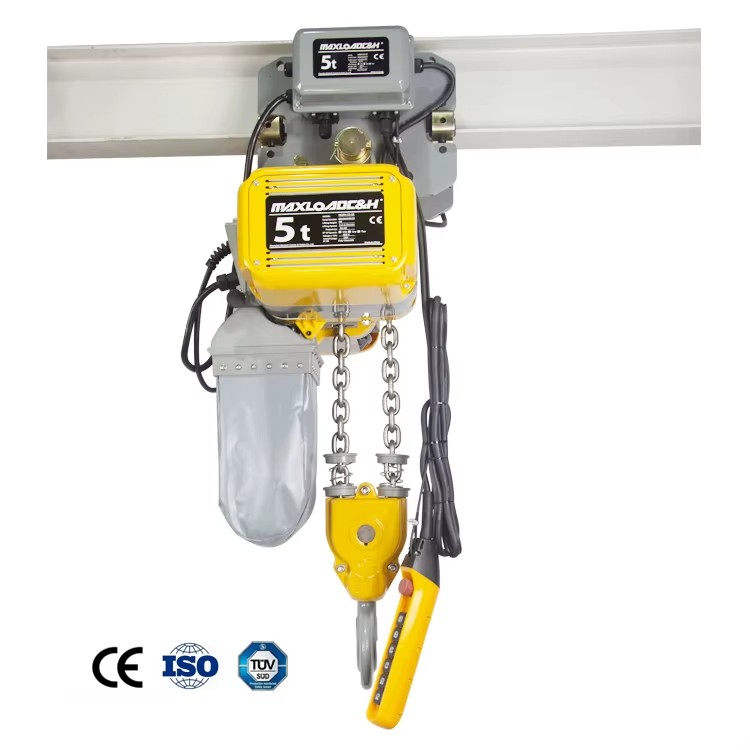
The way the hoist exists at the workstation also affects the user experience. Fixed suspension type performs only vertical lifting, suitable for loading and unloading workpieces at fixed points; push-travel trolley type allows lateral movement along a monorail, suitable for short-distance transfer between workstations; motorized trolley type is used for frequent, long-distance rail travel. If the workstation layout may be adjusted in later project stages, the flexibility of a push trolley is superior to the fixed type; if the rail span is large and travel is frequent, the physical effort saved by a motorized trolley over an eight-hour shift is considerable.
The choice of operating method is equally pragmatic. The length of the pendant control cable must cover the operator's actual standing range—too long is cumbersome and tangled, too short restricts movement. Wireless remote control is suitable for workstations where the operator needs to stand away from the hook to observe load attitude, but in locations with signal interference risk, wired pendant control should remain the first choice. For assembly workstations requiring precise positioning, the tactile feedback and inching sensitivity of pendant buttons are more important than the convenience of remote control.
The endpoint of selection is not finding "the best hoist," but finding the one with the fewest conflicts with workstation constraints. Clearance limits eliminate certain models, duty class eliminates certain specifications, environmental certification eliminates certain configurations—the remaining options are inherently few. By checking the above five dimensions one by one against actual workstation data, the selection decision no longer relies on experience or intuition, but becomes a technical checklist that can be verified item by item.
 0086 156 1824 5535
 0086 156 1824 5535