Engineering Logic and Practical Judgment in Electric Hoist Selection
When many people select an electric hoist, their first instinct is to ask, "How much can it lift?" Tonnage certainly has to be calculated, but if you focus only on load parameters during the workstation survey stage, another kind of awkwardness often appears after the equipment is installed: the hook cannot reach the machine tool farthest away, or workers find lifting too slow and simply stop using it, or the motor frequently overheats and trips within less than half a year. The root cause is not tonnage, but that the workstation environment was not used as the first filter during selection.
The selection logic for electric hoists is essentially about making the equipment adapt to the workstation, not making the workstation accommodate the equipment. Below, this is broken down into four dimensions: spatial geometry, work rhythm, environmental media, and installation interfaces.
Spatial Geometry: Clearance Height Determines the Product Family, Not the Model
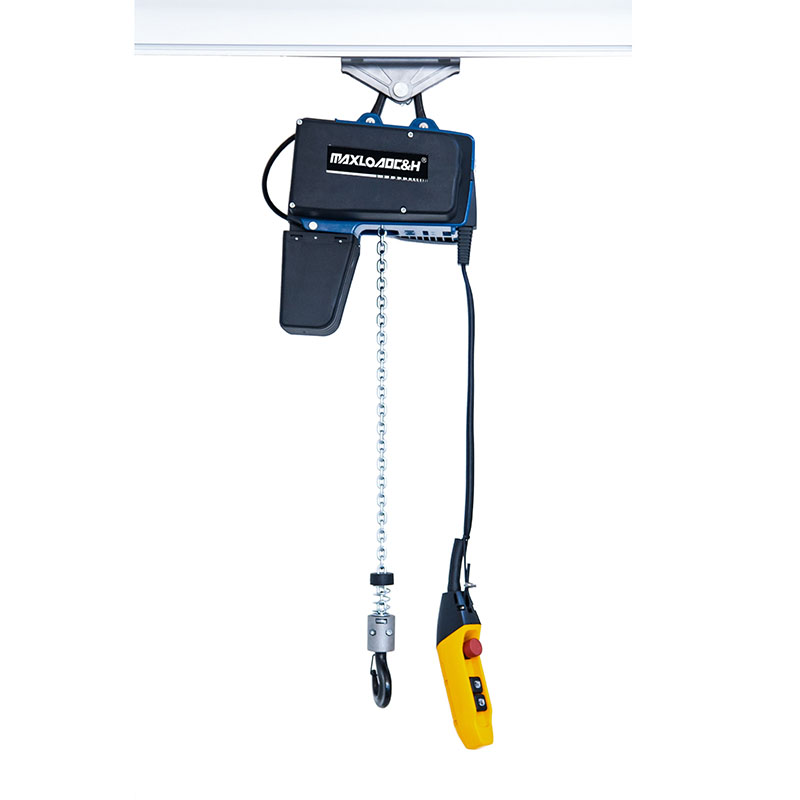
How much clear height remains above the workstation is the first dimension to measure during selection. The drum of a traditional wire rope electric hoist needs to accommodate a sufficient length of wire rope, so its axial dimension is relatively large. When installed in an old factory building with low clear height, the effective travel left for the hook is often very limited. The axial dimension of the chain wheel of a chain hoist is only about 1.6 times the chain width, so the body is noticeably thinner. If pipelines, cable trays, or building beams above the workstation have already reduced the clear height, the chain type is almost the only comfortable choice.
The horizontal coverage range also needs to be confirmed in advance. A stationary hoist can only work below one suspension point, making it suitable for loading and unloading a single machine tool or handling molds at a fixed position; if materials need to flow between multiple workstations, a traveling trolley and track must be provided. Here is a detail that is easily overlooked: the turning radius of the track. For wire rope hoists whose motor axis is parallel to the drum, the turning radius requirement is relatively large, and they may not be able to negotiate a compact annular track; chain hoists with curved-travel trolleys, however, have better track adaptability in compact workstations.
Work Rhythm: Duty Class Is the Baseline for Service Life, Speed Is the Baseline for Efficiency
The duty class parameter is often skipped, but it directly determines how long the equipment will last. According to FEM/ISO standards, the duty class of electric hoists is divided into M3 to M6. In plain terms: M3 corresponds to occasional use, while M6 corresponds to high-frequency continuous operation. The judgment method is not complicated: count how many actual lifting operations the workstation performs each day and how long each lasts. If it is only an occasional lift of a motor during equipment maintenance, M3 is sufficient; if it is an assembly line lifting a workpiece every two minutes, that is a typical high-frequency working condition, and M5 or M6 must be used. Using low-class equipment for high-class work may not show problems in the short term, but after half a year the failure rate will rise noticeably.
Directly linked to duty class is lifting speed. A single-speed hoist has only one lifting speed and is suitable for conventional lifting where positioning accuracy requirements are not high; it has a simple structure and low cost. A dual-speed hoist has fast and slow gears, with the slow gear used for precise positioning when approaching the workpiece, avoiding the hook striking the workpiece or mold. For assembly line workstations, precision workpiece assembly, and sand box mold closing, where "millimeter-level" control is required, dual speed is a necessity rather than an option.
Environmental Media: Corrosion and Explosion Protection Are Two Completely Different Technical Routes
A hoist of the same tonnage and the same space requires completely different configurations when placed in a machining workshop versus a chemical workshop.
An ordinary machining workshop has no special media, so a standard model is sufficient. But if the workstation contains acid-base gases, high humidity, or salt spray, corrosion will begin to spread from the wire rope, chain, and housing coating. The equipment may still look acceptable on the outside, but the internal load-bearing parts have already become brittle. In this case, a corrosion-resistant type should be selected, or the surface treatment grade should be improved on a conventional model. For dusty environments, the nature of the dust must be considered: when ordinary dry particulate matter is mainly iron filings and sand dust, the protection grade of the motor and electrical control box needs to be raised from the conventional IP44 to IP54 or higher; if it is conductive dust or abrasive dust, the sealing requirements must go up another level.
Even more extreme is a flammable and explosive environment. In petrochemical, pharmaceutical, and painting workshops, the hoist's motor, control box, and pushbutton switch may all produce sparks or high-temperature surfaces during normal operation. Placing an ordinary hoist there makes it an ignition source. The logic of an explosion-proof hoist is to enclose all electrical components that may produce sparks in flameproof enclosures; even if an internal explosion occurs, the enclosure can prevent flames from spreading to the external environment. During selection, it is necessary to confirm that the explosion-proof marking matches the hazardous gas classification of the workstation; one cannot simply look at the word "explosion-proof" and place an order.
Installation Interface: Fixed or Traveling, and How the Track Connects
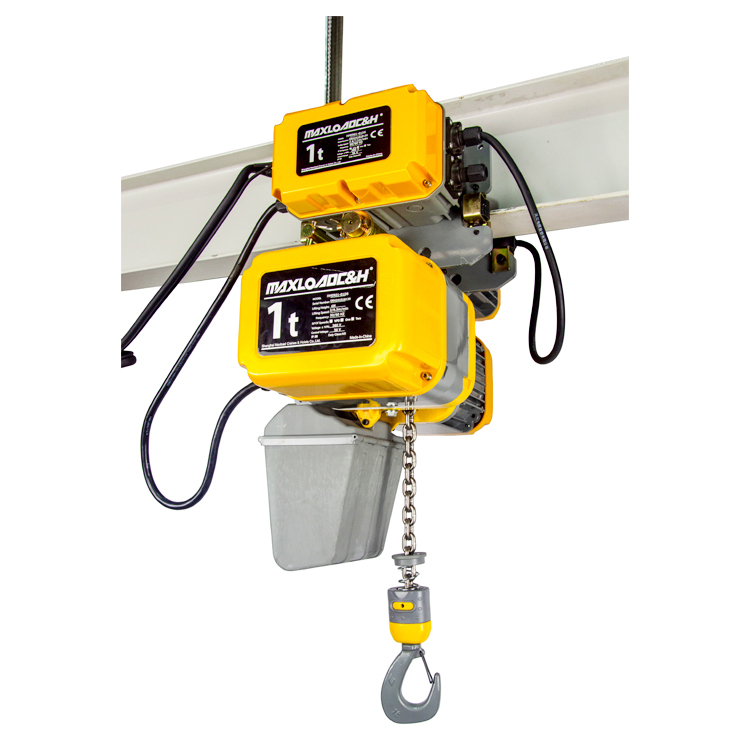
The existing structure of the workstation determines how the hoist is mounted. If there is already an I-beam above the workstation, a traveling hoist can be directly mounted on the track; if it is a new workstation or there is only a concrete ceiling, fixed installation is more realistic. Fixed installation is further divided into suspended fixed and seated fixed. The former is suspended from the lower flange of an H-beam, while the latter sits on a beam or platform, and the available space for choosing the rope outlet direction differs.
There is also a practical issue that easily causes disputes: who supplies the track. Hoist manufacturers usually supply only the hoist body and trolley, while the track, power supply conductor rail, and mounting brackets belong to another supply chain. If the interface dimensions are not aligned during the procurement stage, and when the goods arrive on site it is found that the tread width of the trolley wheels does not match the flange of the I-beam, or that no end stops are installed at the track ends, the equipment can only sit on the ground waiting. A more reliable approach is to photograph the model, flange width, and wear condition of the existing track at the workstation and send them to the supplier for confirmation before placing the order, while also clarifying who provides the track-end buffers and stops.
Closing Remarks
On an electric hoist selection sheet, rated load is only the first line. Every line filled in below it—clearance margin, daily cycle count, environmental corrosion grade, track interface form—is the key to determining whether this equipment can be used "smoothly" at the workstation for three to five years. Understanding the workstation environment thoroughly before opening the catalog is far more reliable than checking models against a tonnage table.
 0086 156 1824 5535
 0086 156 1824 5535