Selection of workstation jib cranes: deriving the configuration from site conditions
The most common mistake in selecting workstation lifting equipment is to look at product catalogs first and then try to fit them to the site. The matching logic for jib cranes and electric hoists is exactly the opposite: first measure the floor, then check the ceiling, then calculate the load, and only finally settle on a specific model. The same 200 kg workpiece may require a completely different solution in a new factory building with ample headroom and in an old workshop densely packed with piping and utilities. The following expands on four site dimensions, each corresponding to a set of configuration decisions.
I. Floor and foundation determine the installation form of the jib crane
The requirements of pillar-mounted jib cranes on the floor are often underestimated. For a unit with a 3-meter jib length and a 500 kg lifting capacity, the overturning moment borne by the base is far greater than most people intuitively expect. The first thing to confirm on site is the concrete thickness and strength: for a floor at least 200 mm thick with strength no lower than C25, chemical anchors can be used for direct fixing; if the thickness is insufficient or pipes are buried underneath, local demolition followed by pouring an independent foundation is the more reliable approach. A conventional foundation is about 1 meter square and around 1 meter deep, with the specific dimensions subject to confirmation by force calculation. In workshops where the floor truly cannot be touched, the load-bearing margin of the factory steel columns can be checked instead, and a wall-mounted solution can be adopted to save the floor space occupied by a pillar.
The reason this judgment is critical is that it directly eliminates some options. Mobile jib cranes appear flexible, but workstation operations emphasize positioning stability and repeatability. A wheeled base inevitably shifts slightly during frequent starts and stops, which instead increases correction costs over long-term use. Once a fixed installation has the right foundation, half of all subsequent precision problems are eliminated.
II. Clearance height constrains the hoist type and jib structure
The clear height under the workshop beams determines the margin between the "total height" of the jib crane and the "effective lifting height." The actual usable lifting stroke is the total pillar height minus the jib beam height, the hoist's own height, and the length of the lifting attachment. In old factory buildings, a clear height of just over 3 meters under the beams is common; with a standard chain hoist plus an I-beam jib, the hook hits the top before it has even reached the workpiece height.
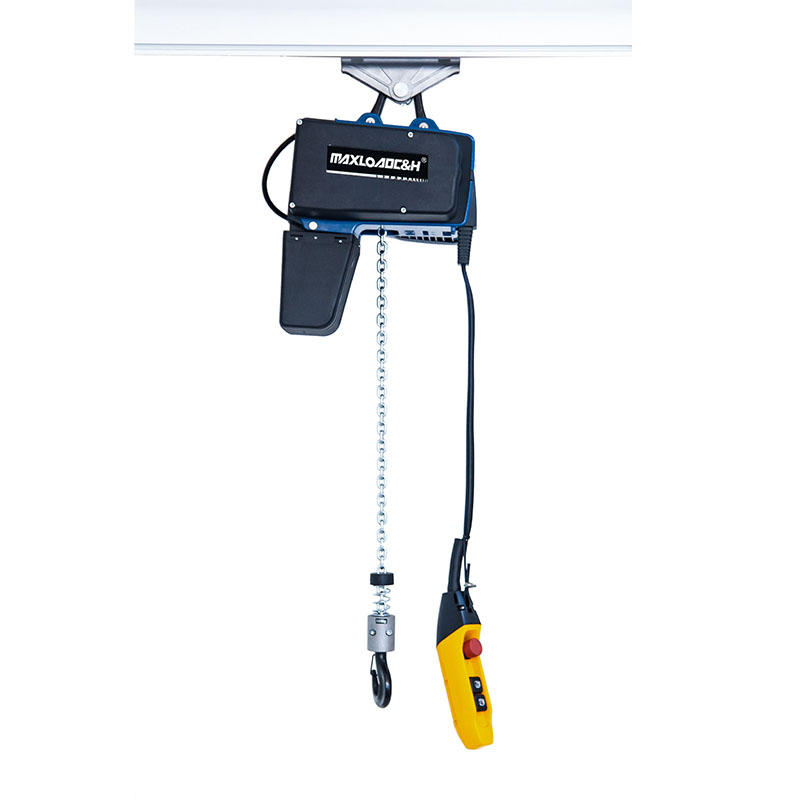
At this point there are two paths: first, switch to a low-headroom hoist, which is compact and trades some maintenance convenience for height; second, change the jib structure from an I-beam to a box girder or aluminum alloy flat rail, reducing the beam's own height by a certain amount. If headroom is truly severe, a tie-rod jib saves more height than a cantilever-supported jib, at the cost of a slightly narrower effective working space beneath the jib. These trade-offs have no universal answer; you have to take a tape measure and deduct segment by segment on site.
III. Workpiece characteristics determine the hoist type: chain or wire rope
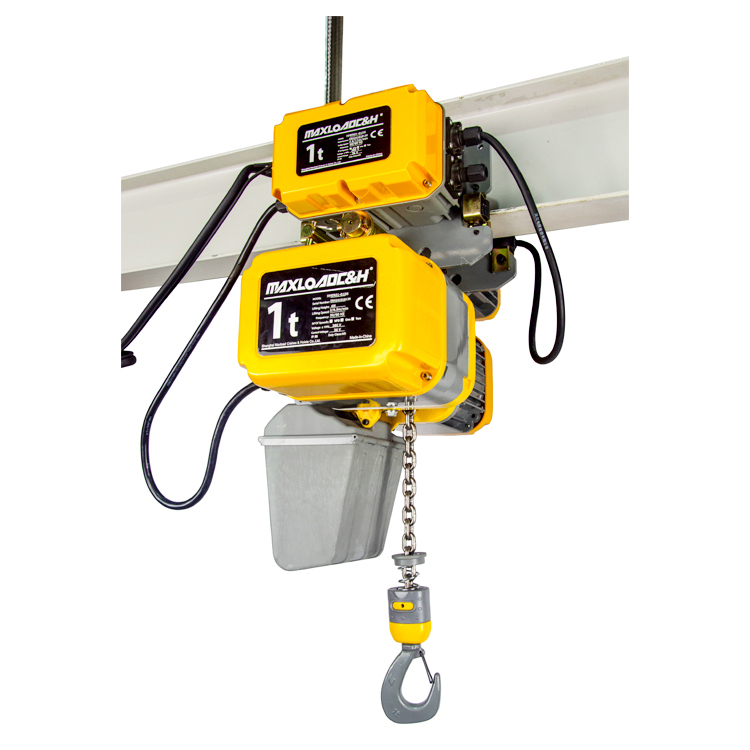
In workstation scenarios, chain hoists generally have broader applicability. Their advantage is not in the parameter table but in the usage details: chain length can be adjusted according to the actual lifting height, and when the workstation is modified later, the chain can simply be replaced to extend it, whereas the rope length of a wire rope hoist is fixed at the factory. Workstation lifting is characterized by high frequency and short individual trips, and the chain hoist's small, lightweight body places less burden on the jib.
The place for wire rope hoists is in large tonnages and long travel. For capacities above 5 tons, or occasions requiring continuous multi-shift high-frequency operation, the smoothness and durability of wire rope justify the extra dead weight and volume. Most machining workstations lift blanks or finished parts weighing between tens and hundreds of kilograms, which chain hoists fully cover, so there is no need to pay for capacity you will not use.
IV. Environmental media determine the protection rating, and this is non-negotiable
Using an ordinary hoist in dust, corrosive, or flammable environments is not a matter of reduced service life; it is a matter of safety accidents. Dust entering the motor or limit switch in a dusty workshop may cause jamming at best and short circuits at worst; the acid-base atmosphere around chemical or electroplating workstations can cause pitting corrosion on chains and housings within a few months.
The judgment logic is simple: if there are flammable gases or combustible dust around the workstation, a hoist with the corresponding explosion-proof rating must be selected, and the explosion-proof rating must match the on-site medium and cannot be used interchangeably; if there are acid-base vapors or salt spray, choose a corrosion-resistant type—light corrosion protection relies on coatings, while severe environments require stainless steel chains and housings; for pure dust without explosion risk, focus on the sealing protection of the motor and electrical box. If this step is wrong, all subsequent selection is invalidated.
V. Put the parameters on paper
Once the site conditions are clear, the calculation becomes simple instead. For lifting capacity, use the heaviest workpiece multiplied by a 1.1 safety margin; for a 200 kg workpiece, choose 220 kg or above. For the slewing radius, measure from the pillar center to the farthest working point of the hook, and note that the coverage is a sector area rather than a full circle; the workstation layout determines whether the dead zones are acceptable. For lifting height, work backward from the workpiece lifting height plus the lifting attachment length plus a 300 mm margin, ensuring that the workpiece does not hit the jib when the hook is at the upper limit.
There is one more point that is easily overlooked: jib cranes with a rated lifting capacity below 3 tons are not included in the special equipment catalog, so the inspection and registration process can be omitted, but daily limit switch checks and overload protection tests cannot be skipped. Equipment not requiring inspection does not mean it can be ignored; workstation lifting accidents often happen in those moments when people "thought it was fine."
The endpoint of selection is not buying a piece of equipment with compliant parameters, but ensuring that the operator still finds it handy and safe three years later. Floor thickness, clear height under the beams, workpiece weight, and what is in the air—the answers to these four questions are written on site, not in catalogs. Walking around the workshop with a tape measure and a thickness gauge is more useful than flipping through ten selection manuals.
 0086 156 1824 5535
 0086 156 1824 5535