Matching a Jib Crane with an Electric Hoist: A Practical Selection Guide
When sourcing a jib crane, many buyers tend to ask about price first, check the lifting capacity second, and only then look at the actual workstation. That order is backwards. A jib crane is equipment that must follow the workstation, not the other way around. The same rated capacity, installed in different workshops, can call for entirely different structures, foundations, and hoist configurations. Work it in the right sequence—survey the site first, review the operating conditions, then match the hoist—and every dollar goes where it should.
Three Hard Conditions of the Workstation
Is there a column or wall to lean on? Jib cranes fall into two main categories: free-standing (column-mounted) and wall-mounted. If the workshop has load-bearing columns and the structure is rated to take the additional forces, a wall-mounted jib crane saves the cost of a full column and a large foundation. For steel-structure buildings, first confirm whether the column can carry the added bending moment—consult the original design office if necessary. Without a structure to anchor to, a free-standing column type is the only option, and the foundation becomes the key cost item.
Can the floor take the load? The column foundation is the lifeline of a free-standing jib crane. For units under 1 ton, a concrete footing of roughly one square meter with adequate embedment depth is generally sufficient. For 2- or 3-ton units, the footing dimensions and reinforcement must be recalculated against the soil bearing capacity. Many workshops sit on backfilled ground or have buried pipelines beneath the slab. In those cases, either relocate the crane or pour an independent foundation—never cut corners by relying on expansion anchors alone. When a jib crane slews with a rated load, the bending moment at the column base is substantial; a loose foundation turns the entire machine into a hazard.
Is there enough headroom? Headroom determines the hoist's lifting travel. Measure three lines: the height of the underside of the boom, the height of the hoist body itself, and the safety clearance between the hook at its highest position and the bottom of the boom. Buyers often report "three meters or more of clearance" after measuring the site, only to find that the actual lift height is barely over a meter once the hoist is installed—nowhere near enough for molds or material bins. Where headroom is tight, choose a low-headroom hoist design or mount the boom higher; it is worth paying a little more for installation.
Coverage: Don't Overspecify the Boom Length
A longer boom covers a wider work area, but the bending moment at the column root grows with the square of the boom length. The column, foundation, and slewing bearing all need to be upsized accordingly, and the price curve climbs steeply.
The practical approach is to sketch the workstation layout: mark the pick-up point and the set-down point, and the boom only needs to sweep across those two points. There is no need to "cover the whole workshop." Effective boom lengths of 3 to 6 meters are common; beyond 6 meters, a gantry or rail system is often the more economical solution.
The slewing method should also match the frequency of use. Manual push-pull slewing is simple and low-cost, suited to lighter lifts performed a few dozen times a day. For high-frequency workstations, powered slewing is the better choice—operators control the hoist with one hand and the slewing with the other, improving both efficiency and safety.
Matching the Electric Hoist: Look at Travel and the Load
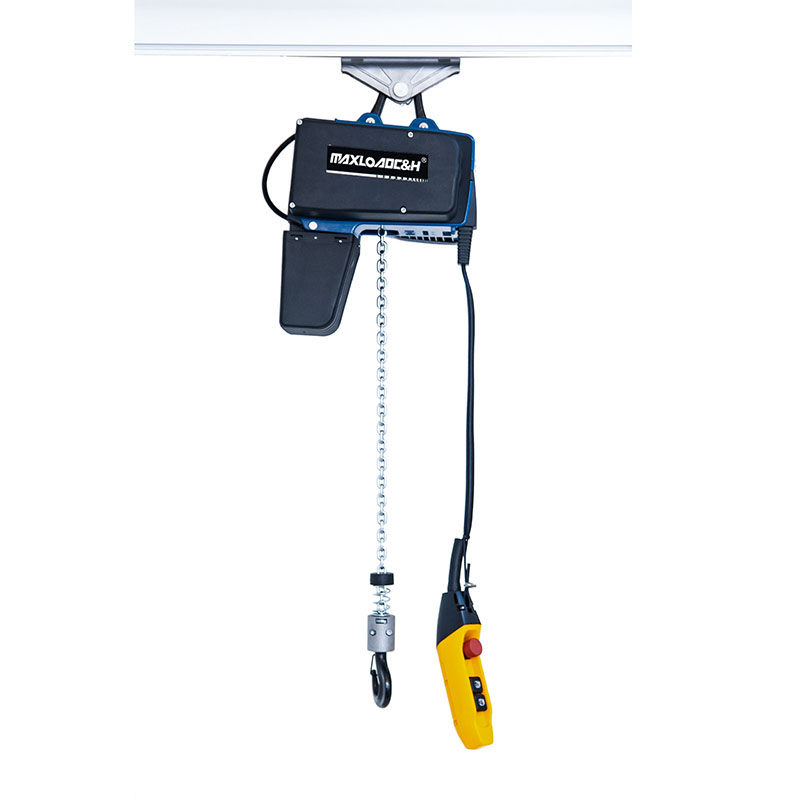
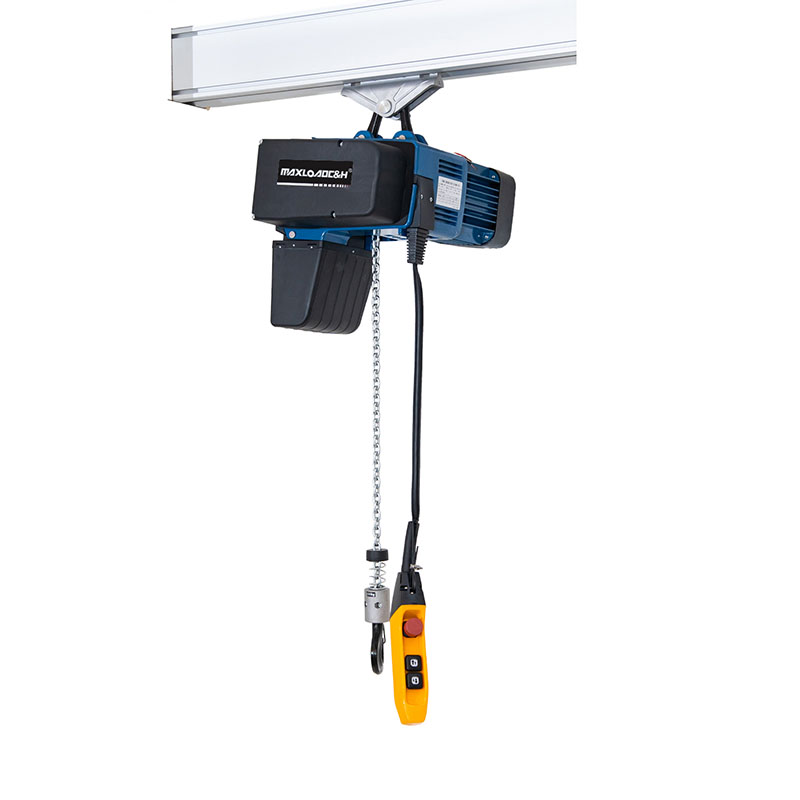
The hoist most commonly fitted to a jib crane is the electric chain hoist, and the selection mainly comes down to lifting height and the nature of the load.
A chain hoist takes up little space and has a compact, low-profile body. Lifting heights typically range from 3 to 10 meters, which suits workstations with limited headroom and moderate travel requirements—making it the standard choice for jib cranes.
How much capacity margin to leave is an old question. A sound rule of thumb: take the heaviest routine load, multiply by 1.25 to 1.5, and round up to the nearest standard capacity. A workstation that regularly lifts 500 kg needs only a 0.5-ton hoist—there is no need to jump to 1 ton. An oversized hoist adds self-weight, which eats into the effective lifting capacity, and usually lifts more slowly, which actually hurts performance.
Duty classification is easy to overlook. A workstation running two shifts with a hundred or more lifting cycles per day must use a hoist rated one duty class higher; otherwise, the motor and brake will wear out prematurely, and the cost of downtime and replacement parts far exceeds the price saved up front.
Allow Extra Margin for Special Environments
For an ordinary machining workshop, standard configurations are fine. But if the workstation is outdoors, the boom and hoist both need weather and corrosion protection, and the electrical components should be rated at least IP54. In foundries and grinding shops with heavy dust, choose a fully enclosed hoist and step up routine inspections. In chemical areas with flammable or explosive media, the entire unit must be configured to explosion-proof requirements—there is no room for compromise here.
Low and high temperatures also affect the selection. In cold storage, for example, conventional lubricants thicken, so low-temperature-rated components are required. Confirm every one of these details with the supplier item by item before signing the contract, and put them in writing in the technical agreement.
Final Word
The jib crane plus electric hoist combination is, in essence, a dedicated mini overhead crane built around a fixed workstation. Its value lies in how well it fits that workstation, so the logic of selection should start from the site itself: site conditions determine the structure, lifting parameters determine the capacity and travel, and environmental conditions determine the configuration details. Survey the site thoroughly, describe the operating conditions clearly, and then let the equipment fit the operator—rather than making the operator work around the equipment. Spending half a day measuring the site before purchase buys ten years of safe, dependable lifting. That is a trade worth making every time.
 0086 156 1824 5535
 0086 156 1824 5535